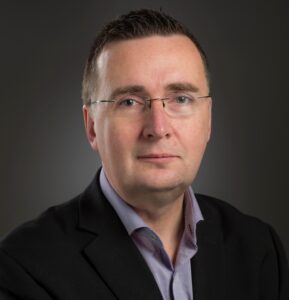
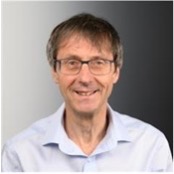
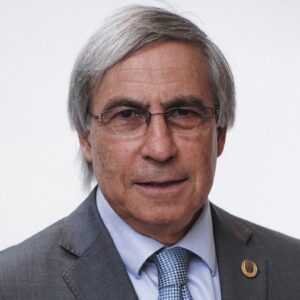
IUPAC has five Officers: The President, the Vice President, the Past President, the Secretary General, and the Treasurer.

The President is the administrative head of the Union, and chairs the meetings of the Council and the Executive Board. The President reports on the State of the Union at each biennial meeting of the Council.

The Vice President chairs the Science Board and provides them with a critical assessment of the programs and the projects of all IUPAC bodies. As President-Elect, the Vice President assumes the office of President if the President is unable to perform their official duties. Such representation does not affect the subsequent term as President.

The Secretary General carries out the business of the Union as specified by the governance bodies of the Union, and is responsible for keeping its records and for the administration of the Secretariat.

The Treasurer is responsible for the accounts of the Union. This includes preparing the biennial budget of the Union, expenditure approvals, and responsibility for the investment and custody of the funds of the Union. The Treasurer ensures that an appropriate record of all financial authorities and transactions is maintained.
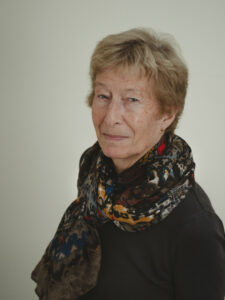
[Past Officers]

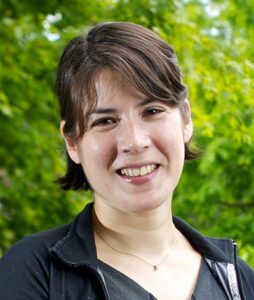
Mary Garson (Australia), President,

Mary Garson (Australia), President

Mary Garson is Professor Emerita of Chemistry at the University of Queensland (UQ) in Brisbane, Australia. She was educated at Newnham College within the University of Cambridge, UK (BA in natural sciences 1974; PhD with Professor James Staunton FRS 1977, topic: the biosynthesis of fungal polyketides). After postdoctoral fellowships in Rome and Cambridge, she migrated to Australia with a Queen Elizabeth II research fellowship held at James Cook University, Townsville where she began her research into marine natural products and their biosynthesis. Academic positions at the University of Wollongong and then in Queensland followed.

Mary is a Past President of Division III (organic and biomolecular) of IUPAC and has served twice on the Bureau of IUPAC (divisional representative 2014-2015; elected member 2018-2021). She was co-chair of the IUPAC100 Management Committee overseeing the centenary celebrations in 2019, and in the 2022-2023 biennium has served as the inaugural Chair of the Committee for Ethics, Diversity, Equity and Inclusion (CEDEI). Her contributions to IUPAC also include as Executive Secretary for the General Assembly/World Chemistry Congress in Brisbane in 2001 and in organisation of various Division III symposia. She is best known as the creator of a global networking breakfast for women chemists held in 2011 to celebrate the International Year of Chemistry, and which since its rebranding as the IUPAC Global Women’s Breakfast (GWB) event in 2019 has resulted in >1500 events in 100 countries. Mary has been Chair of the International Relations Committee of the Royal Australian Chemical Institute and Chair of Australian Science Innovations overseeing their science Olympiad programs. She is currently serving on the National Committee for Chemistry of the Australian Academy of Science.

An unusual form of professional recognition is the naming of a new species of marine flatworm as Maritigrella marygarsonae. In 2023, the American Chemical Society Journal of Natural Products published a special issue recognising her outstanding contributions to natural products chemistry. Mary holds a Distinguished Fellowship of the Royal Australian Chemical Institute. She is also a Fellow of the Royal Society of Chemistry (UK), and in 2014 was named as one of their “175 faces of Chemistry”. In 2019, she was appointed a Member of the Order of Australia for significant service to education and as an advocate for women in science.

Mary was a SCUBA diver for many years, but now prefers hiking and Pilates as well as listening to classical music.


> Link to the PRESIDENTS FORUM

mgarson@iupac.org
Mary Garson (Australia), President

Christine Luscombe (Japan), Vice President,

Christine Luscombe (Japan), Vice President

Christine Luscombe is a Japanese-British chemist known for her work in polymer chemistry and organic electronics. Born and raised in Kobe, Japan, she pursued her undergraduate studies at Trinity College, University of Cambridge, earning a Bachelor’s degree in Natural Sciences in 2000. She continued at Cambridge for her doctoral research under the mentorship of Professors Andrew Holmes and Wilhelm Huck in the Melville Laboratory for Polymer Synthesis, focusing on surface modifications using supercritical carbon dioxide. Her work during this period was recognized with the Syngenta Award for the best organic chemistry project. In 2004, she joined Professor Jean Fréchet’s group at the University of California, Berkeley, as a postdoctoral fellow. There, she initiated her research on semiconducting polymers for organic photovoltaics, supported by the Lindemann Fellowship and a Junior Research Fellowship from Trinity College, Cambridge. Christine began her independent academic career in 2006 as an Assistant Professor in the Materials Science and Engineering Department at the University of Washington, Seattle. In 2021, she returned to Japan to join the Okinawa Institute of Science and Technology (OIST) as a Full Professor, where she continues her research and contributes to academic leadership.

Beyond her research, Christine has played a number of roles in scientific publishing and professional organizations. She has served on the Editorial Advisory Boards of several journals, and in 2024, she was appointed Editor-in-Chief of Polymer Chemistry. Her leadership extends to international scientific communities, where she has been actively involved with IUPAC since 2016; she served as Vice President of the Polymer Division from 2016 to 2019, President from 2020 to 2023, and was elected to the Executive Board in 2024.

christine.luscombe@iupac.org
Christine Luscombe (Japan), Vice President

Zoltán Mester (Canada), Secretary General,

Zoltán Mester (Canada), Secretary General

Zoltán Mester was born and raised in Hungary. He completed his PhD in splitting his time between his alma mater in Budapest and the Italian National Agency for New Technologies, Energy and Sustainable Economic Development (ENEA) in Rome, Italy. In 1999 he joined the Chemical Metrology program of the National Research Council (NRC) in Ottawa, Canada. His research encompasses analytical mass spectrometry, sample preparation, metrology in chemistry and trace element speciation. He published over 250 peer-reviewed papers and over the years he gave numerous invited and keynote presentations at various conferences and he lectures regularly at universities and research institutions around world.
He has been serving as an adjunct professor at Queen’s and Ottawa Universities in Canada contributing to the training of the next generation of analytical chemists.
He has been with IUPAC since the Ottawa General Assembly in 2003 and has served in numerous leadership roles including two terms as the President of Analytical Chemistry Division (2018-2019, 2020-2021) and also as an Elected member of the last Bureau of the Union (2022-2023).
For more than a decade he represented Canada at the Consultative Committee for Amount of Substance (CCQM), the “chemistry arm” of the Metre Convention. At CCQM he championed stable isotope ratio metrology and initiated a new work program coordinating international standard development activities in this field.
Stating from 2024 for a period of four years he will be serving as the Secretary General of the Union.

zmester@iupac.org
Zoltán Mester (Canada), Secretary General

Derek Craston (UK), Treasurer,

Derek Craston (UK), Treasurer

Derek Craston is a highly experienced scientist and business leader with a broad background in applied chemistry and expertise in leading business activities, and in setting and delivering corporate and scientific strategies. Derek has a proven track record in successful commercial and financial management, and in running complex multinational divisions and scientific teams. Although based in the UK, Derek has worked internationally and run operations in the US, Germany and China, and been involved in establishing laboratories in India. During his long career in industry, he assumed several important roles including UK Government Chemist and as an Executive Board member and Chief Scientific Officer of a successful international Lifesciences Business.

Derek has been an active contributor to IUPAC since 2014 and has previously been President of the Analytical Chemistry Division and a member of the Science Board. He has been a task group member of several IUPAC projects. As a member of the Science Board, Derek was  a major contributor to drafting documents on strategic priorities, scientific objectives and alternative organisational structures.

derek.craston@iupac.org
Derek Craston (UK), Treasurer

Ehud Keinan (Israel), Past President,

Ehud Keinan (Israel), Past President

Ehud Keinan is Benno Gitter & Ilana Ben-Ami Professor of Chemistry at the Schulich Faculty of Chemistry, Technion – Israel Institute of Technology. He was born and educated in Israel, obtained his Ph.D. from the Weizmann Institute of Science under the supervision of Prof. Y. Mazur, and conducted postdoctoral research at the University of Wisconsin with Prof. B.M. Trost. His areas of interest include biocatalysis with antibodies and synthetic enzymes, organic synthesis, molecular computing, supramolecular chemistry, improvised explosives, and drug discovery. He was Dean of the Technion Schulich Faculty of Chemistry, an Adjunct Professor at The Scripps Research Institute, La Jolla, California (1991-2014), the founder and first Head of the Institute of Catalysis Science and Technology at the Technion, and the founder of two startup companies. He served as Pro-Vice-Chancellor and Dean of Sciences at GTIIT, Guangdong, China (2015-2016), and since 2020, he has held a Distinguished Visiting Chair at the Academia Sinica. Ehud initiated and led several national projects in Israel, including the Archimedes and Negev-Nobel projects, which promoted gifted high school pupils, as well as the Chemistry Olympiad.
Ehud is a public writer and activist on science education, higher education, energy policy, and the chemical industry. Keinan initiated and led a public campaign in Israel that successfully resulted in the removal of a hazardous liquid ammonia tank from a densely populated area in Haifa Bay. This significant achievement is detailed in his book, “The Ammonia War.” In recognition of his contributions to public safety, a prominent Israeli newspaper named him “Man of the Year.”

ekeinan@iupac.org
Ehud Keinan (Israel), Past President