

The International Union of Pure and Applied Chemistry (IUPAC) and Solvay are pleased to announce the winners of the 2026 IUPAC-Solvay International Award for Young Chemists.
This prestigious award recognizes the best Ph.D. theses in the chemical sciences, as described in 1000-word essays.
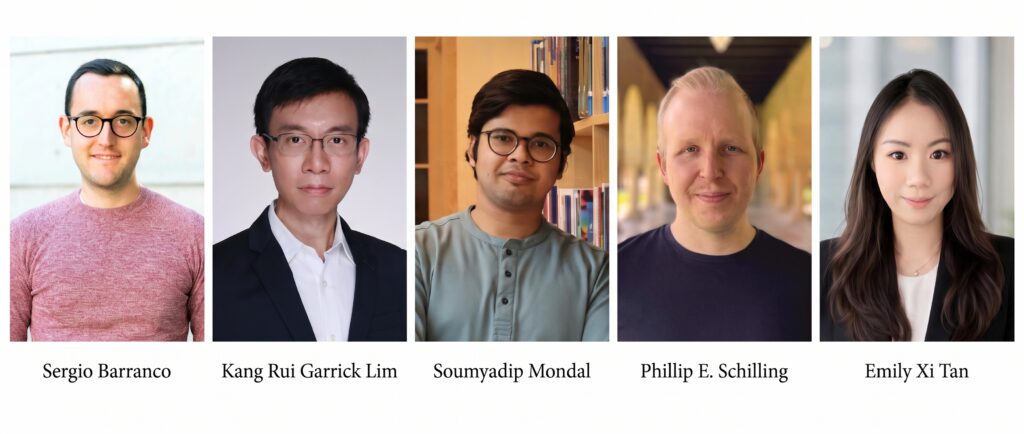
2026 Award Winners
Each of the five winners, representing diverse research fields and regions, will receive a cash prize of USD 1000 and travel support to the 2027 IUPAC Congress in Montreal, Canada (July 9–16, 2027). Winners are invited to present a poster at the Congress and submit a short critical review on their research for publication in Pure and Applied Chemistry.
Dr. Sergio Barranco (Spain) – Institute of Chemical Research of Catalonia (ICIQ), Spain
“Harnessing the Mechanistic Potential of Reaction Intermediates in Cp*CoIII-Catalyzed C–H Functionalization Reactions”
https://orcid.org/0000-0001-5489-7755 | linkedin
Dr. Kang Rui Garrick Lim (Singapore) – Harvard University, USA
“Raspberry-colloid-templated catalysts as a model thermocatalytic platform”
https://orcid.org/0000-0003-2159-9844 | linkedin | institutional profile
Dr. Soumyadip Mondal (India) – Institute of Science & Technology Austria (ISTA), Austria
“Oxygen and Sulfur Redox: Conversion Kinetics and Phase Equilibria”
https://orcid.org/0000-0001-8082-4891 | linkedin
Dr. Philipp E. Schilling (Austria) – ETH Zurich, Switzerland
“Potassium Acyltrifluoroborates (KATs) for Chemical Protein Synthesis and Modifications”
https://orcid.org/0000-0003-4996-5367 | linkedin | institutional profile
Dr. Emily Xi Tan (Singapore) – Nanyang Technological University, Singapore
“Utilizing chemical domain knowledge and machine learning for nanoparticle and biochemical spectroscopic analysis”
https://orcid.org/0000-0001-5643-974X | linkedin | researchgate | google scholar
This year’s competition received 45 applications from Ph.D. graduates across 24 countries. The award selection committee was chaired by Professor Ehud Keinan, IUPAC Past President. The awards will be formally presented at the Opening Ceremony of the 2027 IUPAC Congress, where winners of both the 2026 and 2025 competitions will be honored.
2027 Award Applications
The call for applications for the 2027 IUPAC-Solvay International Award for Young Chemists will be announced soon. Eligible candidates must have received a Ph.D. or equivalent degree in 2026 from an institution in a country with an IUPAC National Adhering Organization.
About Solvay
Solvay, a pioneering chemical company with a legacy rooted in founder Ernest Solvay’s pivotal innovations in the soda ash process, is dedicated to delivering essential solutions globally through its workforce of over 9,000 employees. Since 1863, Solvay harnesses the power of chemistry to create innovative, sustainable solutions that answer the world’s most essential needs such as purifying the air we breathe and the water we drink, preserving our food supplies, protecting our health and well-being, creating eco-friendly clothing, making the tires of our cars more sustainable and cleaning and protecting our homes. Solvay’s unwavering commitment drives the transition to a carbon-neutral future by 2050, underscoring its dedication to sustainability and a fair and just transition. As a world-leading company with €4.7 billion in net sales in 2024, Solvay is listed on Euronext Brussels and Paris (SOLB). For more information about Solvay, please visit solvay.com or follow Solvay on Linkedin.
About IUPAC
IUPAC was formed in 1919 by chemists from industry and academia. Since then, the Union has succeeded in fostering worldwide communications in the chemical sciences and in uniting academic, industrial and public sector chemistry in a common language. IUPAC is recognized as the world authority on chemical nomenclature, terminology, standardized methods for measurement, atomic weights and many other critically evaluated data. In more recent years, IUPAC has been pro-active in establishing a wide range of conferences and projects designed to promote and stimulate modern developments in chemistry, and also to assist in aspects of chemical education and the public understanding of chemistry. More information about IUPAC and its activities is available at iupac.org.
> Announcement published in the issue of Chem International
Dr. Sergio Barranco:
LinkedIn: https://www.linkedin.com/in/sergio-barranco-raflus-6926aa2b8/
Dr. Sergio Barranco obtained his BSc in Chemistry from the Autonomous University of Madrid (UAM). He subsequently joined the Pérez-Temprano research group at the Institute of Chemical Research of Catalonia (ICIQ), where he pursued his MSc and later completed his PhD in 2025. His doctoral research focused on elucidating the mechanistic intricacies of Cp*Co(III)-catalyzed C–H functionalization reactions, with particular emphasis on hydrogen isotope exchange (HIE) processes. During his PhD, he also undertook a four-month research stay at the University of California, Berkeley, under the supervision of Prof. John F. Hartwig, where he further expanded his experience in mechanistic organometallic chemistry and catalysis.
Dr. Kang Rui Garrick Lim:
ORCID: https://orcid.org/0000-0003-2159-9844
LinkedIn: https://www.linkedin.com/in/krglim/
Institutional profile: https://profiles.stanford.edu/garrick-lim
Lab Website: https://krglimlab.github.io/
Dr. Kang Rui Garrick Lim is a Stanford Energy Postdoctoral Fellow with Prof. Matteo Cargnello and Prof. Thomas F. Jaramillo at Stanford University (2025–2027). Garrick completed his Ph.D. and Master’s degree in chemistry at Harvard University (2020–2025) under Prof. Joanna Aizenberg, where he integrated colloidal templating and self-assembly concepts into catalyst design to design 3D macroporous inverse opal structures bearing partially embedded dilute alloy nanoparticles to serve as a model thermocatalytic platform. Garrick obtained his Bachelor’s degree in chemistry from the National University of Singapore (2015–2019) and worked as a research officer at the A*STAR Institute of Materials Research and Engineering in Singapore (2019–2020) before starting his Ph.D. In 2027, Garrick will return to Singapore to start his independent research career as a Nanyang Assistant Professor at the School of Materials Science & Engineering in Nanyang Technological University (NTU), Singapore. Garrick’s broad research interest is to leverage on the colloidal design of catalytic architectures–their active sites and immediate environment–to bridge the materials complexity gap in catalyst design for low carbon energy research.
Dr. Soumyadip Mondal:
ORCID: 0000-0001-8082-4891
LinkedIn: https://www.linkedin.com/in/soumyadip-mondal-346a5b84/
Soumyadip Mondal is currently a Postdoctoral researcher at the Fritz Haber Institute of the Max Planck Society in Berlin. He completed his PhD at the Institute of Science and Technology Austria (ISTA) under the supervision of Prof. Stefan Freunberger, where his research focused on charge-transfer mechanisms in oxygen and sulfur redox materials. Before starting his PhD, Soumyadip completed his BSc in Industrial Chemistry and his MSc in Applied Chemistry at Ramakrishna Mission Vidyamandira in India. He received several achievements during his academic career, including selection to attend the 71st Lindau Nobel Laureate Meeting in 2022 and, more recently, the Young Chemists’ Award (Silver medal, PhD level) from the European Chemical Society.
Dr. Philipp E. Schilling (Austria) – ETH Zurich, Switzerland:
ORCID: 0000-0003-4996-5367
LinkedIn: http://www.linkedin.com/in/philipp-schilling-pes
Institutional profile: https://profiles.stanford.edu/philipp-schilling
Philipp E. Schilling received his B.Sc. and M.Sc. in Chemistry from the University of Vienna (Austria), where he became fascinated by organic chemistry and its application to biomolecules. He completed his Ph.D. in Chemistry at ETH Zurich (Switzerland) under the guidance of Prof. Jeffrey W. Bode, working on chemical protein synthesis – a technique to assemble proteins from synthetic peptide segments, which allows the introduction of site-specific modifications. His thesis work established the amide-bond forming KAT ligation as a method for chemical protein synthesis that proceeds under aqueous conditions at micromolar concentrations. Separately, he developed reactions for site-specific peptide and protein modification, as well as chemical linkers for preparing glycoconjugate vaccine candidates against antibiotic-resistant bacteria; the latter led to the ETH spin-off Baxiva. The thesis was awarded the ETH Medal for an outstanding doctoral thesis. He is currently an SNSF Postdoctoral Fellow with Prof. Matthew Bogyo at Stanford University (USA) and develops platforms for covalent inhibitor and imaging-probe discovery.
Dr. Emily Xi Tan:
ORCID: https://orcid.org/0000-0001-5643-974X
LinkedIn: https://www.linkedin.com/in/emily-xi-tan-a83252370/
ResearchGate: https://www.researchgate.net/profile/Emily-Tan-22
Google scholar: https://scholar.google.com/citations?user=s10dBDIAAAAJ&hl=en
Emily is a Singaporean chemist and Postdoctoral Research Fellow at the Institute for Digital Molecular Analytics and Science. Born and raised in Singapore, she earned a B.Sc. in Chemistry (2020) and a Ph.D. in Chemistry (2025) from Nanyang Technological University, Singapore, where she conducted her doctoral research under the supervision of Prof. Ling Xing Yi. Her doctoral research focused on elucidating molecular behavior at plasmonic nanoparticle interfaces by integrating spectroscopy and machine learning. Her work bridges fundamental chemistry with computational approaches to advance molecular-level understanding, with applications in sensing, catalysis, and medical diagnostics.