

The Royal Swedish Academy of Sciences has decided to award
the Nobel Prize in Chemistry 2025 to
Susumu Kitagawa, Kyoto University, Japan,
Richard Robson, University of Melbourne, Australia, and
Omar M. Yaghi University of California, Berkeley, USA,
“for the development of metal–organic frameworks” [1]
Congratulations to Susumu Kitagawa, Richard Robson, and Omar M. Yaghi for receiving the Nobel Prize in Chemistry for their pioneering work on metal–organic frameworks (MOFs)—materials that are set to revolutionize chemistry and sustainability.
This achievement resonates with the mission of IUPAC: advancing global chemical knowledge through collaboration and standardization.
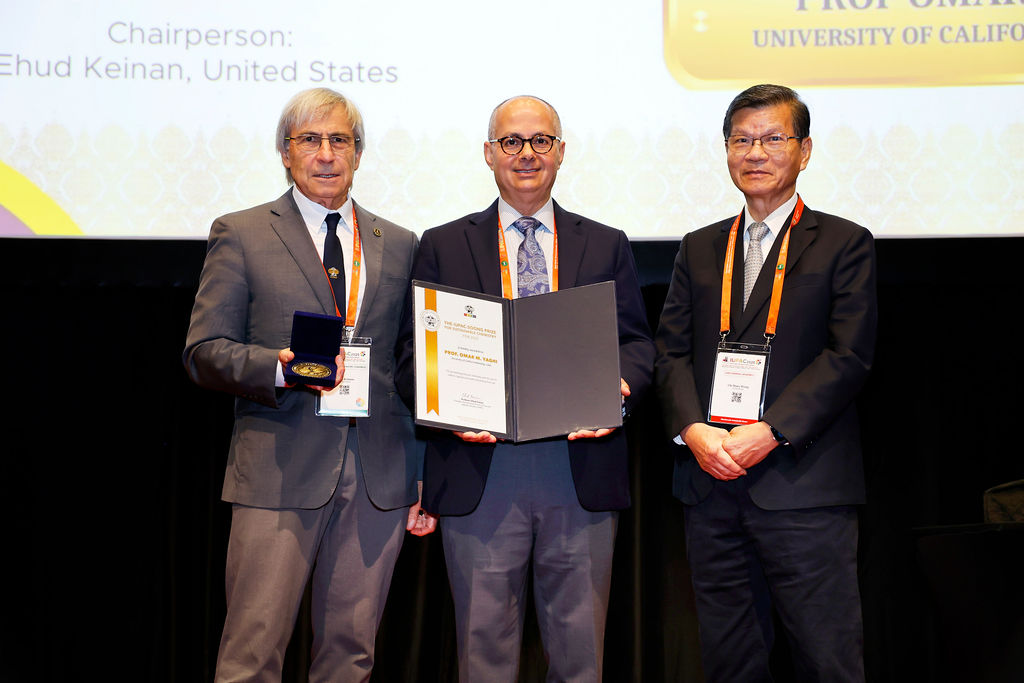
Omar Yaghi was honored earlier this year as the inaugural recipient of the IUPAC-Soong Prize for Sustainable Chemistry, recognizing his leadership in Reticular Chemistry and MOFs for carbon capture and water harvesting. Learn more about the IUPAC-Soong Prize [2].
Susumu Kitagawa helped shape the language of this field by working in an IUPAC project team and co-authoring the 2013 IUPAC Recommendations on MOF terminology (Pure and Applied Chemistry, 2013), ensuring clarity and consistency for researchers worldwide. Read the PAC paper [3].
These milestones highlight how scientific breakthroughs and global consensus-building go hand in hand—from defining how to talk about “metal–organic framework” to enabling technologies that tackle climate and resource challenges.
In 2019, MOFs was named one of the Top 10 Emerging Technology in Chemistry by IUPAC [4]. To be selected at that time, the technology “needed to be exciting and have the capacity to open up new opportunities in chemistry and beyond and help to solve major global problems” — a prospect that this year’s Nobel Prize in Chemistry celebrates.
👏 Let’s celebrate these visionaries and the collaborative spirit that drives chemistry forward!
 [1] “Their molecular architecture contains rooms for chemistry”, Nobel release, 8 Oct 2025, https://www.nobelprize.org/prizes/chemistry/2025/press-release/
See the more detailed Scientific background to the Nobel Prize in Chemistry 2025 (pdf, from nobelprize.org)
[2] Omar M. Yaghi Receives the 2025 IUPAC-Soong Prize for Sustainable Chemistry, 7 Apr 2025, https://iupac.org/omar-m-yaghi-receives-the-2025-iupac-soong-prize/
[3] “Terminology of metal–organic frameworks and coordination polymers (IUPAC Recommendations 2013)” Pure Appl Chem, 2013, p. 1715, https://doi.org/10.1351/PAC-REC-12-11-20 (cited in the detailed scientific background [1])
outcome of IUPAC project “Coordination polymers and metal organic frameworks: terminology and nomenclature guidelines”, Lars R. Öhrström et al, 1 Aug 2009, https://iupac.org/project/2009-012-2-200/
[4] IUPAC announces the top ten emerging technologies in chemistry, 1 Apr 2019, https://iupac.org/iupac-announces-the-top-ten-emerging-technologies-in-chemistry/
and Gomollón-Bel, Fernando. “Ten Chemical Innovations That Will Change Our World: IUPAC identifies emerging technologies in Chemistry with potential to make our planet more sustainable” Chemistry International, vol. 41, no. 2, 2019, pp. 12-17. https://doi.org/10.1515/ci-2019-0203
#NobelPrize #Chemistry #MOFs #ReticularChemistry #IUPAC #SustainableChemistry #ScientificStandards