


Implement a culture of safety, security, sustainability, and responsibility in the practice of chemistry.
Overview
The practice of chemistry should be carried out with careful consideration for the health of people and the environment, particularly in light of the hazardous properties of chemicals, and to prevent illegal, harmful, or destructive uses of chemicals and the misuse of facilities where they are manufactured or used.

Chemical safety practices protect people and the environment from hazardous materials. Security measures protect chemicals from their intentional misuse by people. Chemical sustainability refers to the process of designing, using, and disposing of chemicals in ways that reduce risks to human health and the environment. The responsible practice of chemistry requires careful consideration of each of these concepts, along with a commitment to ethical standards and active community engagement. The chemistry community must address the safety, security, and sustainability of chemicals and chemical products over their full life cycle, from manufacture to use to disposal.
Examples
Chemical Security: OPCW Work and The Hague Ethical Guidelines
Chemical safety is only part of a chemist’s responsibility to ensure that chemistry is not used for harm. Chemists must also consider issues of chemical security, such as making sure that the toxic chemicals they can access are not misused by others.
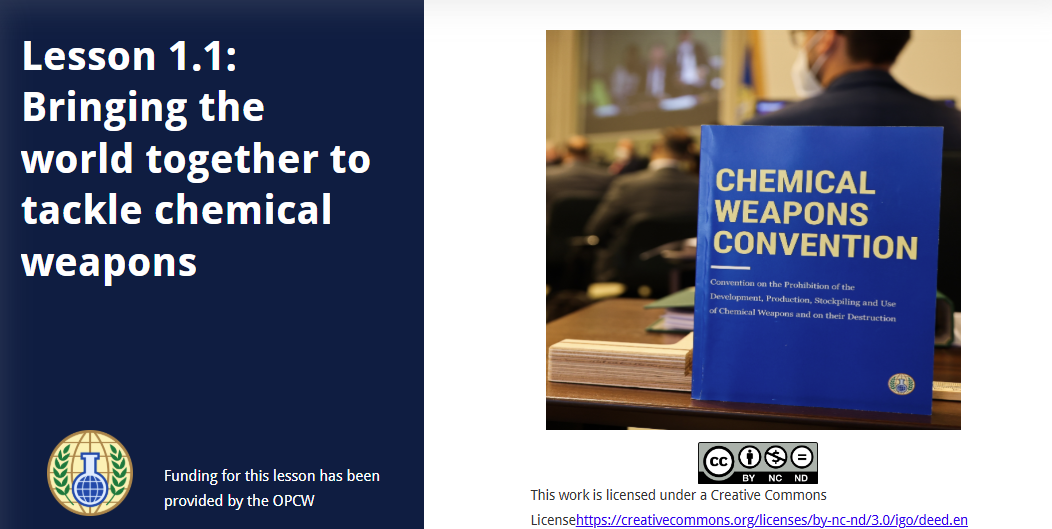
The Chemical Weapons Convention (CWC), implemented by the Organisation for the Prohibition of Chemical Weapons (OPCW),11 is an international nonproliferation treaty that was designed to rid the world of chemical weapons and prevent their future use. This agreement is currently the world’s most successful disarmament treaty, working to ensure that chemistry is solely being used for good.12 Recognizing the importance of reaching future practitioners of chemistry, OPCW created a series of lessons to educate the public and university students on chemical weapons, with emphasis on safety, security, and the responsible uses of chemistry.13 These lessons focus on chemical weapons, other chemical security issues, and how to protect both humans and the environment from the misuse of chemistry.
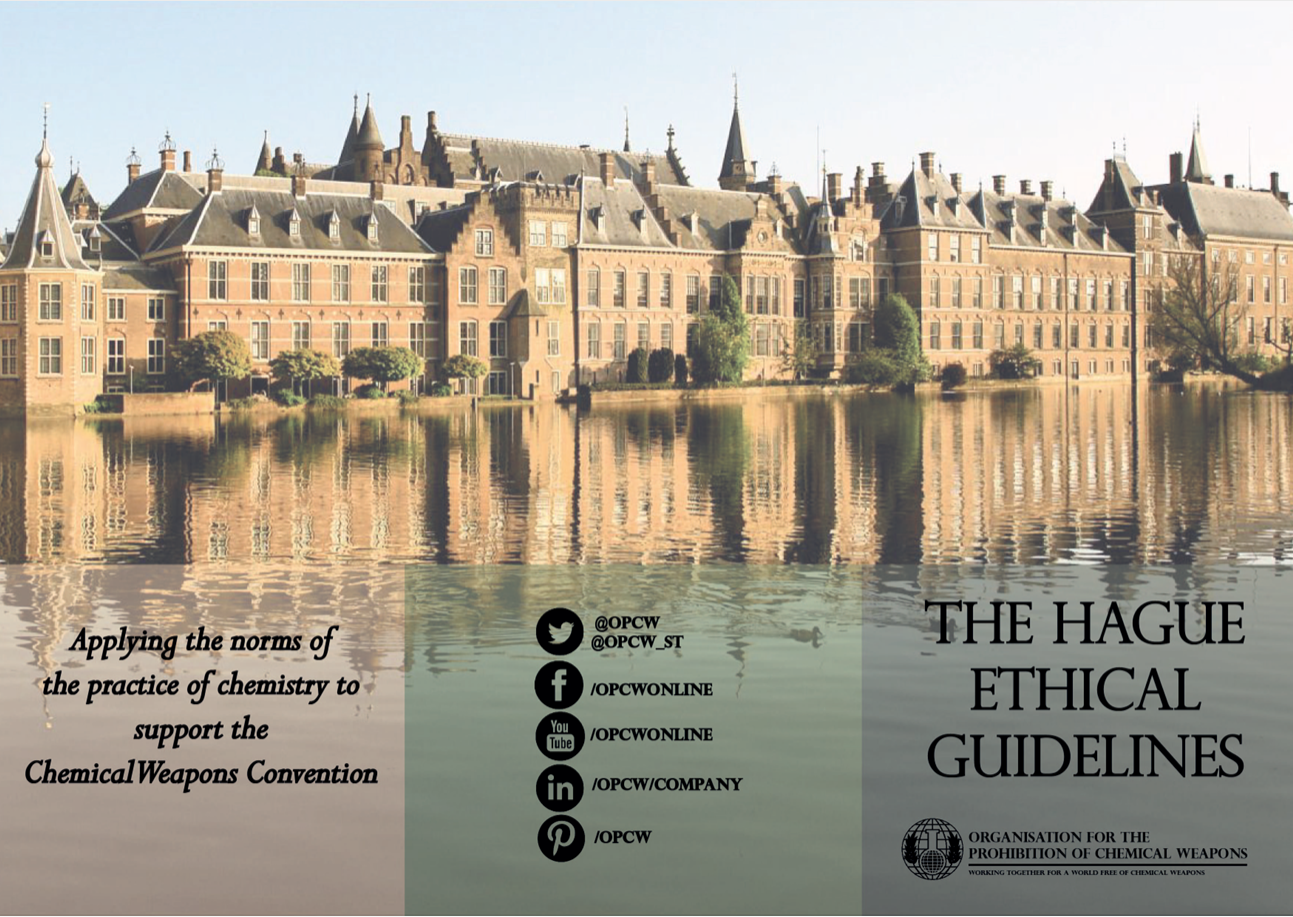
The Hague Ethical Guidelines were created by a group of international chemists, facilitated by OPCW, as an outline of the fundamental concepts related to the ethical practice of chemistry in the context of the CWC.14 These guidelines highlight safety, security, and sustainability as key components to the responsible use of chemistry and the protection of the health and well-being of people and the planet. The CWC and the Hague Ethical Guidelines are examples of important initiatives to integrate safety, security, and sustainability into the current chemistry culture.
Guiding Future Action
By applying systems thinking, chemists consider the entire lifecycle of a chemical substance, from its production to its disposal. This approach helps improve safety, enhance security, and advance sustainability by reducing hazards, minimizing risks, and limiting environmental impact.
Systems Thinking in Chemistry for Sustainability: Toward 2030 and Beyond is an IUPAC project that provides resources, tools, and case studies to help educators implement systems-thinking approaches in teaching, and to help them connect chemistry education to sustainability.16-17
One major outcome of the IUPAC initiative has been the release of the open-access Sustainability and Systems Thinking in Chemistry Education (SaSTICE) online resources to provide chemistry educators with the tools to implement systems thinking while teaching chemistry, so as to better equip students with the knowledge, reasoning, and practices they need to tackle multiple global challenges.18
An ongoing follow-up IUPAC project, Systems Thinking, Sustainability and Chemical Industry, provides a channel for collaboration among chemical companies and IUPAC to facilitate dialogue, collaboration, and commitment to tackle sustainability challenges. The taskforce for this project is developing case studies on more sustainable polymers and conducting a systems evaluation of ammonia, an important inorganic material. This work will demonstrate how systems thinking can identify strategies for increasing the sustainability of ammonia and hydrogen as molecular energy carriers.
In May 2025, the Nobel Symposium on Chemistry for Sustainability, hosted by the Stockholm University Center for Circular and Sustainable Systems, gathered leading experts in green chemistry to discuss the main advances in the field. A product of those rich discussions was The Stockholm Declaration on Chemistry for the Future (www.stockholm-declaration.org), which calls for “creating new methods to make [chemicals] that are aligned with the goals of advancing human well-being while preserving the essential biosphere and geosphere that allows life to exist.” The declaration includes a call to action of all chemists to design chemicals and processes that are safe and sustainable by design. It also emphasizes the need for chemistry to generate open-access data and information relating to the safety and sustainability of chemicals, and to encourage policies that disincentivize polluting, toxic, and dangerous chemical practices. The declaration also calls for collaboration among scientists, industrial leaders, educators, students, and policy makers to generate solutions to global challenges using safe and sustainable chemistry practices.
Questions to Guide Discussion
- What is the difference between chemical safety and chemical security? Why is this differentiation important?
- How can safety, security, and sustainability be applied and prioritized in your own life and/or work environment?
- Reflect on the historical developments in the field of chemistry—how have chemical safety, security, and sustainability progressed?
- In your opinion, what has been the most significant improvement in chemistry safety, security, and sustainability practices?
- How does sustainability relate to chemical safety and chemical security?
- Provide examples of how sustainability practices enhanced safety or security in your own work or in industry. What about when sustainability practices hindered safety or security?
- What are the current challenges in chemical safety, security, and sustainability? In your opinion, which of these challenges require the most attention?
- How can new technologies or practices address the current challenges in chemical safety, security, and sustainability?
- What is “systems thinking” in the context of chemical safety, security, and sustainability?
- How can systems thinking improve practices in chemical safety, security, and sustainability?
References
- Center for Chemical Process Safety of the American Institute of Chemical Engineers. Building Process Safety Culture: Tools to Enhance Process Safety Performance; AIChE: New York, 2005. https://www.aiche.org/sites/default/files/docs/embedded-pdf/Flixborough-Case-History_0.pdf.
- Health and Safety at Work etc. Act 1974. https://www.legislation.gov.uk/ukpga/1974/37/contents (accessed 2025-06-14).
- The Control of Major Accident Hazards Regulations 1999. https://www.legislation.gov.uk/uksi/1999/743/contents/made (accessed 2025-06-14).
- Eskenazi, B.; Warner, M.; Brambilla, P.; Signorini, S.; Ames, J.; Mocarelli, P. The Seveso Accident: A Look at 40 Years of Health Research and Beyond. Environ. Int. 2018, 121 (Pt 1), 71–84. https://doi.org/10.1016/j.envint.2018.08.051.
- European Chemicals Agency (ECHA). Substance Information – 2,3,7,8-tetrachlorodibenzo[b,e][1,4]dioxin. https://echa.europa.eu/substance-information/-/substanceinfo/100.015.566 (accessed 2025-06-14).
- U.S. Chemical Safety and Hazard Investigation Board (CSB). Mixed Connection, Toxic Result. https://www.csb.gov/videos/mixed-connection-toxic-result/ (accessed 2025-06-14).
- U.S. Chemical Safety and Hazard Investigation Board (CSB). On 30th Anniversary of Fatal Chemical Release That Killed Thousands in Bhopal, India, CSB Safety Message Warns It Could Happen Again. https://www.csb.gov/on-30th-anniversary-of-fatal-chemical-release-that-killed-thousands-in-bhopal-india-csb-safety-message-warns-it-could-happen-again-/ (accessed 2025-06-14).
- Lemonick, S. 25 Years After Karen Wetterhahn Died of Dimethylmercury Poisoning, Her Influence Persists. Chem. Eng. News, https://cen.acs.org/safety/lab-safety/25-years-Karen-Wetterhahn-died-dimethylmercury-poisoning/100/i21 (accessed 2025-06-14).
- Kemsley, J. 10 Years After Sheri Sangji’s Death, Are Academic Labs Any Safer? Chem. Eng. News, https://cen.acs.org/safety/lab-safety/10-years-Sheri-Sangjis-death/97/i1 (accessed 2025-06-14).
- U.S. Chemical Safety and Hazard Investigation Board (CSB). Experimenting with Danger. https://www.csb.gov/videos/experimenting-with-danger/ (accessed 2025-06-14).
- Organisation for the Prohibition of Chemical Weapons (OPCW). https://www.opcw.org/node/2632 (accessed 2025-06-14).
- Organisation for the Prohibition of Chemical Weapons (OPCW). Achieving Universality of the Convention. https://www.opcw.org/our-work/achieving-universality-convention (accessed 2025-06-14).
- Organisation for the Prohibition of Chemical Weapons (OPCW). OPCW and Its Mission: Bringing the World Together to Tackle Chemical Weapons. https://learn.opcw.org/mod/h5pactivity/view.php?id=1707 (accessed 2025-06-14).
- Organisation for the Prohibition of Chemical Weapons (OPCW). The Hague Ethical Guidelines. https://www.opcw.org/hague-ethical-guidelines (accessed 2025-06-14).
- International Council of Chemical Associations (ICCA). Responsible Care®. https://icca-chem.org/focus/responsible-care/ (accessed 2025-06-14).
- Mahaffy, P. G.; Elgersma, A. K. Systems Thinking, the Molecular Basis of Sustainability and the Planetary Boundaries Framework: Complementary Core Competencies for Chemistry Education. Curr. Opin. Green Sustain. Chem. 2022, 37, 100663. https://doi.org/10.1016/j.cogsc.2022.100663.
- Talanquer, V.; Szozda, A. An Educational Framework for Teaching Chemistry Using a Systems Thinking Approach. J. Chem. Educ. 2024, 101 (5), 1785–1792. https://doi.org/10.1021/acs.jchemed.4c00216 .
- IUPAC. Sustainability and Systems Thinking in Chemistry Education. SaSTICE. https://sastice.com/ (accessed 2025-06-14).