


Employ scientific knowledge and encourage innovations in chemistry to maximize benefits for people and the planet while minimizing and mitigating unintended consequences.
Overview
Chemists and chemistry organisations should be responsible stewards of the environment and use scientific evidence to find sustainable solutions to the planet’s most pressing challenges, while minimizing the risk of unforeseen harmful effects. The early history of the development of chemical processes and products was often characterized by a linear “take-make-dispose” approach, which paid insufficient attention to the lifecycles of substances, and to unintended consequences of their production.1 Several examples are given below of chemistry innovations that were clearly beneficial for many people, but resulted in unintended harmful consequences. Moving forward, chemistry can and must be conducted with a deliberate focus on anticipating and mitigating harmful consequences for people and the planet, while still producing essential products.
Examples
Leblanc Process
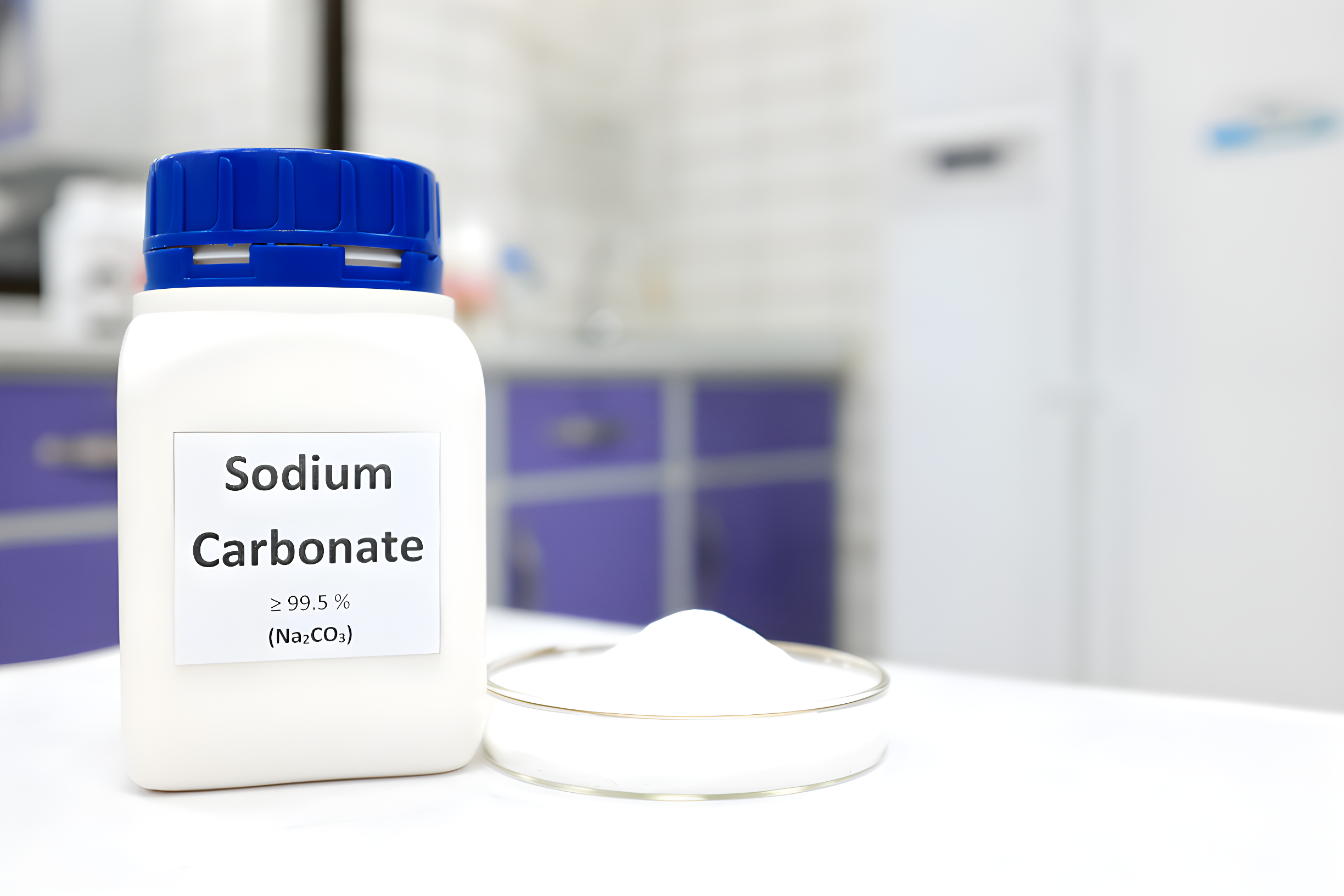
For centuries, innovations brought about through chemistry have improved the quality of life for humankind. Advances in chemistry have led to the development of pharmaceuticals, plastics, electronics, and agrochemicals that have benefited society in many ways, but have often come with unintended consequences.2 One of the early examples of this pattern involves sodium carbonate, one of the first chemicals produced at an industrial scale using the Leblanc process, which was invented by Nicolas Leblanc. This process transformed the textile industry and laid the foundation for modern chemical industry.3 Sodium carbonate, also known as soda ash, was in great demand in the late 1700s as a feedstock to produce bleaches, dyes, glass, and soap.
The early methods to produce soda ash were expensive, and in 1783, the French Academy of Sciences—at the behest of King Louis XVI—offered a prize for someone who could produce soda ash from sodium chloride. In response, Leblanc developed a new process to accomplish this goal and was granted a patent to begin industrial production in 1791. Leblanc’s process transformed chemical industry and improved the economy.4 While this new process was innovative, calcium sulphate waste was produced, and hydrogen chloride gas was released into the atmosphere, which killed trees, plants, and animals, damaged buildings, and adversely affected human health. Public pressure and legislation, including the Alkali Act of 1863, led to production innovations and more responsible stewardship of the environment. Over time, a novel process to produce sodium carbonate emerged that produced only one principal waste product, calcium chloride, which had substantially fewer adverse effects.4 Further refinements of the process led to the elimination of calcium chloride as a waste product. The Leblanc process illustrates what can happen when chemists innovate without sufficiently anticipating harmful consequences.
Haber-Bosch Process
It is estimated that over the past century, the Haber-Bosch process for nitrogen fixation has supported roughly 50 percent of the world’s population by producing ammonia for nitrogen-based agricultural fertilizers.5 German chemist Fritz Haber was awarded a controversial Nobel Prize6 in Chemistry in 1918 for co-inventing the process. However, this inefficient and power-intensive process consumes over 1 percent of the world’s total energy production and accounts for roughly 1.4 percent of global carbon dioxide emissions.5 A large portion of the emissions result from the energy-intensive production of the hydrogen feedstock for this process, and most of that hydrogen is currently derived from fossil fuels.7
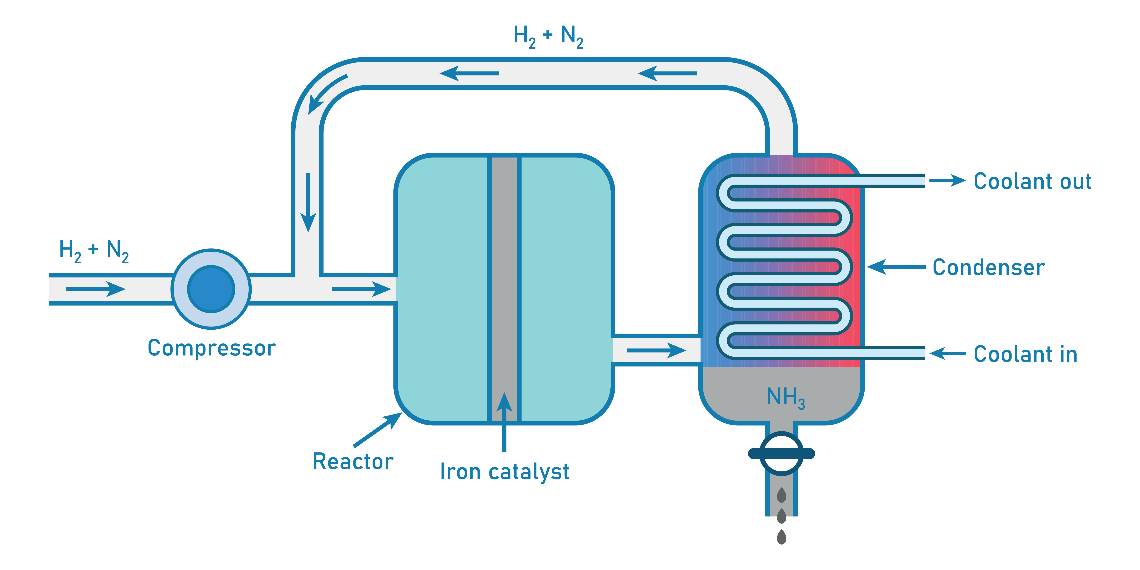
Even though the Haber-Bosch process is inefficient, it has proved to be highly reliable and scalable and is still the dominant method for ammonia production because of its practicality and large-scale output. However, in recent decades, there has been a growing effort among chemists, other scientists, policymakers, and the public to utilize systems thinking in relation to ammonia production. Systems thinking means analyzing the entire ammonia value chain and considering all of the interconnected components and how they interact and what long-term effects may result. For example, one of the consequences of fertilizer overapplication is that it leads to environmental challenges such as nitrogen runoff into water bodies, causing eutrophication, and increased atmospheric release of nitrous oxide, a potent greenhouse gas and stratospheric ozone depleter. For chemists, responsible innovation involves research and development programs that lower the environmental impact of this process. Strategies include implementing new sources for hydrogen production that do not rely on fossil fuels, developing new catalysts to reduce energy use, and developing more sustainable methods of fertilizer application to reduce waste.5
Refrigerants
Refrigerants, the working fluids used in refrigerators, freezers, heat pumps, and air conditioners, are essential to our daily lives to preserve food in homes as well as in the transport and retail sectors. Refrigerants are also essential for keeping vaccines cool and maintaining comfortable and safe temperatures in homes and cars. Innovative chemistry led to the production of chlorofluorocarbons (CFCs) in the 1930s to replace toxic refrigerants like ammonia and sulfur dioxide. CFCs quickly proved to be effective, nontoxic, and inert and were also cheap and easy to produce.8 However, CFCs also had unintended consequences that were not fully realized until almost a half century later. Due to their inert-by-design nature, CFCs are insoluble in water and do not react with hydroxyl radicals that scavenge many tropospheric pollutants. As a result, CFCs have long atmospheric lifetimes, eventually entering the stratosphere where they photochemically decompose to produce chlorine radicals that participate in catalytic-chain ozone-depletion mechanisms. The rapidly diminishing stratospheric ozone layer became so concerning that CFCs were phased out by the Montreal Protocol.9
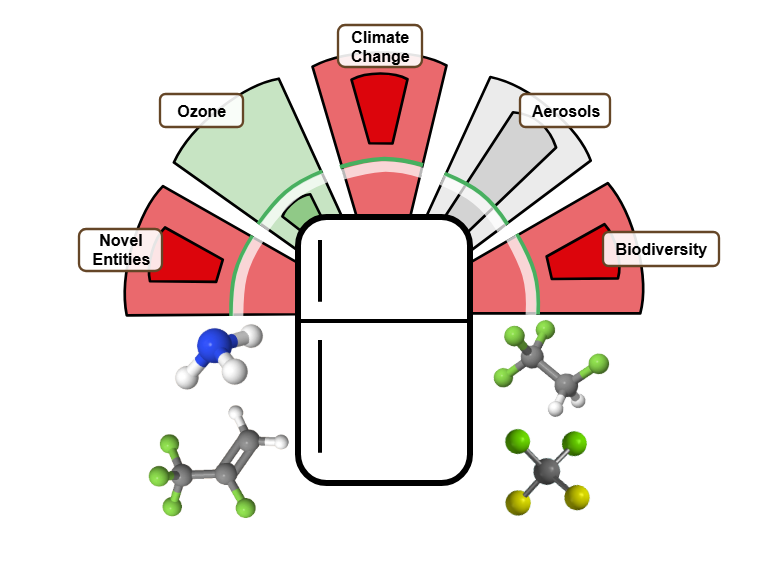
Hydrochlorofluorocarbons (HCFCs), which have shorter atmospheric lifetimes,8 were introduced as replacement compounds. While less damaging, HCFCs still caused ozone depletion. Next, hydrofluorocarbons (HFCs) were developed and adopted as long-term replacement compounds because they have ozone-depletion potentials near zero (HFCs contain no Cl atoms). In working to solve the ozone-depletion problem caused by some refrigerants, the chemistry profession has mostly neglected to use systems thinking to consider other unintended consequences. Specifically, HFCs have been shown to have large global-warming potentials, so HFCs are also being phased out.8 Innovation is ongoing, now benefiting from systems thinking approaches, to find the next generation of refrigerants, as well as novel approaches to refrigeration that move beyond standard vapour-compression technologies. The issue has become pressing due to rapidly growing demands for refrigeration and air conditioning as climate change worsens.
Guiding Future Action
Chemistry can and must be conducted with a deliberate focus on anticipating and mitigating harmful consequences for people and the planet while still producing essential products. The examples provided above demonstrate how chemists can problem solve and adapt to improve processes and products that have unintended consequences. Yet is it enough to just clean up our messes? How do we ensure that going forward, chemical innovation focuses from the beginning on prevention, not just on the reduction of harm?
Chemistry has a long history of pioneering improved processes and products. However, developing new processes and altering existing ones demand careful consideration of the lifecycles of chemicals and the larger Earth and societal systems.11 Responsible innovation from the chemical industry is essential to discover sustainable solutions to the planet’s most pressing challenges, but what should this innovation look like? Sustainable solvents, catalysts, and feedstocks should be utilized in chemistry to achieve syntheses and processes that are green(er) and more sustainable.12 Application of the 12 Principles of Green Chemistry,13 the Criteria for Sustainable Chemistry,14 and the Principles of Circular Chemistry15 should be considered from the beginning in the design and implementation of new innovations.11 And chemical processes should be designed with the synergistic application of green, safe, and circular practices.15

Chemists and the pharmaceutical industry are beginning to consider responsible innovation from the outset rather than as an afterthought. For example, a cocktail of pharmaceutical products and their metabolites are found in many freshwater systems, due to their excretion by humans using those products, and the limited capability of sewage treatment systems to remove them. Long-term exposure to many of these drug residues, which include birth control pills and antidepressants, are harmful to animals and humans because of their ability to disrupt endocrine systems. In response to global concerns about the issue, a SCOPE/IUPAC Project investigated the implications of endocrine-active substances for humans and wildlife in 2003.16 The project’s comprehensive and authoritative review of the risks associated with endocrine disruption has helped guide further research and created a scientific basis of understanding for the wider chemistry community to responsibly consider future consequences resulting from the production of new substances and products. Currently, a “benign by design” approach is being strongly encouraged where new and existing compounds are produced with consideration to their being green, safe by design, and circular. New consideration is being given to design pharmaceutical products that will readily biodegrade in the environment.17 Widespread implementation of these approaches will require both education and new incentives for the pharmaceutical industry, for medical professionals, and for citizens.
Innovations in chemistry must be developed using systems thinking to analyze the entire lifecycle of the components involved, anticipating and including both the hazards and benefits. Systems thinking identifies interconnected components and analyzes potential results from the interaction of those components.2 This type of thinking encourages “zooming out” to obtain a holistic view of the potential issues involved.2 Systems must be considered in their entirety to identify solutions that are unlikely to cause unintended consequences.14
Questions to Guide Discussion
- Give other examples of chemical innovations that have greatly benefited society but also led to unintended consequence(s).
- For each example, how could adopting systems thinking have prevented some of the unintended consequences?
- Look-up the 12 Principles of Green Chemistry, the Criteria for Sustainable Chemistry, and the Principles of Circular Chemistry. What do these principles have in common? In what ways does each principle and group of principles foster responsible innovation?
- Give another example of a “benign by design” approach to the production of chemical products.
- A paper has been published in a leading journal with the provocative title “Modern Chemistry is Rubbish” (reference 1). What do you think the author might be referring to with this title? Then look up the paper and discuss what the author means by this title, and what solutions they propose to address the problem.
- In what specific ways can you employ systems thinking in your education and/or professional career?
References
- Flerlage, H.; Slootweg, J. C. Modern Chemistry Is Rubbish. Nat. Rev. Chem. 2023, 7, 593–594. https://doi.org/10.1038/s41570-023-00523-9.
- Aubrecht, K. B.; Bourgeois, M.; Brush, E. J.; MacKellar, J.; Wissinger, J. E. Integrating Green Chemistry in the Curriculum: Building Student Skills in Systems Thinking, Safety, and Sustainability. J. Chem. Educ. 2019, 96 (12), 2872–2880. https://doi.org/10.1021/acs.jchemed.9b00354.
- Flavell-While, C. Nicolas Leblanc–Revolutionary Discoveries. The Chemical Engineer, 2011. https://www.thechemicalengineer.com/features/cewctw-nicolas-leblanc-revolutionary-discoveries/ (accessed 2024-12-21).
- McGrayne, S. B. Prometheans in the Lab: Chemistry and the Making of the Modern World; McGraw Hill: New York, 2001.
- Whalen, J. M.; Matlin, S. A.; Holme, T. A.; Stewart, J. J.; Mahaffy, P. G. A Systems Approach to Chemistry Is Required to Achieve Sustainable Transformation of Matter: The Case of Ammonia and Reactive Nitrogen. ACS Sustain. Chem. Eng. 2022, 10 (39), 12933–12947. https://doi.org/10.1021/acssuschemeng.2c03159.
- University of York Department of Education. Haber, Ethics and the Nobel Prize. https://www.york.ac.uk/education/research/uyseg/projects/twentyfirstcenturyscience/news/2016/haberethicsandthenobelprize/ (accessed 2024-12-21).
- Capdevila-Cortada, M. Electrifying the Haber–Bosch. Nat. Catal. 2019, 2 (12), 1055–1055. https://doi.org/10.1038/s41929-019-0414-4.
- Mahaffy, P. G.; Elgersma, A. K. Systems Thinking, the Molecular Basis of Sustainability and the Planetary Boundaries Framework: Complementary Core Competencies for Chemistry Education. Curr. Opin. Green Sustain. Chem. 2022, 37, 100663. https://doi.org/10.1016/j.cogsc.2022.100663.
- The Montreal Protocol on Substances that Deplete the Ozone Layer | Ozone Secretariat. https://ozone.unep.org/treaties/montreal-protocol (accessed 2024-12-21).
- King’s Centre for Visualization in Science. Refriger-rate. https://applets.kcvs.ca/refriger-rate (accessed 2024-12-21).
- Marion, P.; Bernela, B.; Piccirilli, A.; Estrine, B.; Patouillard, N.; Guilbot, J.; Jérôme, F. Sustainable Chemistry: How to Produce Better and More from Less? Green Chem. 2017, 19 (21), 4973–4989. https://doi.org/10.1039/C7GC02006F. .
- Anastas, P.; Eghbali, N. Green Chemistry: Principles and Practice. Chem. Soc. Rev. 2010, 39 (1), 301–312. https://doi.org/10.1039/B918763B.
- Anastas, P.; Warner, J. C. Green Chemistry: Theory and Practice; Oxford University Press: New York, 1998; p 30.
- Cannon, A.; Edwards, S.; Jacobs, M.; Moir, J. W.; Roy, M. A.; Tickner, J. A. An Actionable Definition and Criteria for “Sustainable Chemistry” Based on Literature Review and a Global Multisectoral Stakeholder Working Group. RSC Sustainability 2023, 1 (8), 2092–2106. https://doi.org/10.1039/D3SU00217A.
- Slootweg, J. C. Sustainable Chemistry: Green, Circular, and Safe-by-Design. One Earth 2024, 7 (5), 754–758. https://doi.org/10.1016/j.oneear.2024.04.006.
- Miyamoto, J.; Burger, J.; Scientific Committee on Problems of the Environment; International Union of Pure and Applied Chemistry. Implications of Endocrine Active Substances for Humans and Wildlife: Executive Summary. https://publications.iupac.org/pac/2003/7511/exec-summary.pdf (accessed 2024-12-21).
- King, A. Environmentally Benign by Design. Chemistry World, Aug 15, 2017. https://www.chemistryworld.com/features/environmentally-benign-by-design/3007842.article (accessed 2024-12-23).