


Apply ethical values, norms, standards, and judgments to guide the responsible practice of chemistry.
Overview
Chemists should apply established ethical and professional guidelines for scientific conduct throughout the research and development process. Chemists should take individual responsibility for their own professional behaviour while chemistry-related organisations should take collective responsibility for maintaining professional standards.
Examples
Guiding Future Action
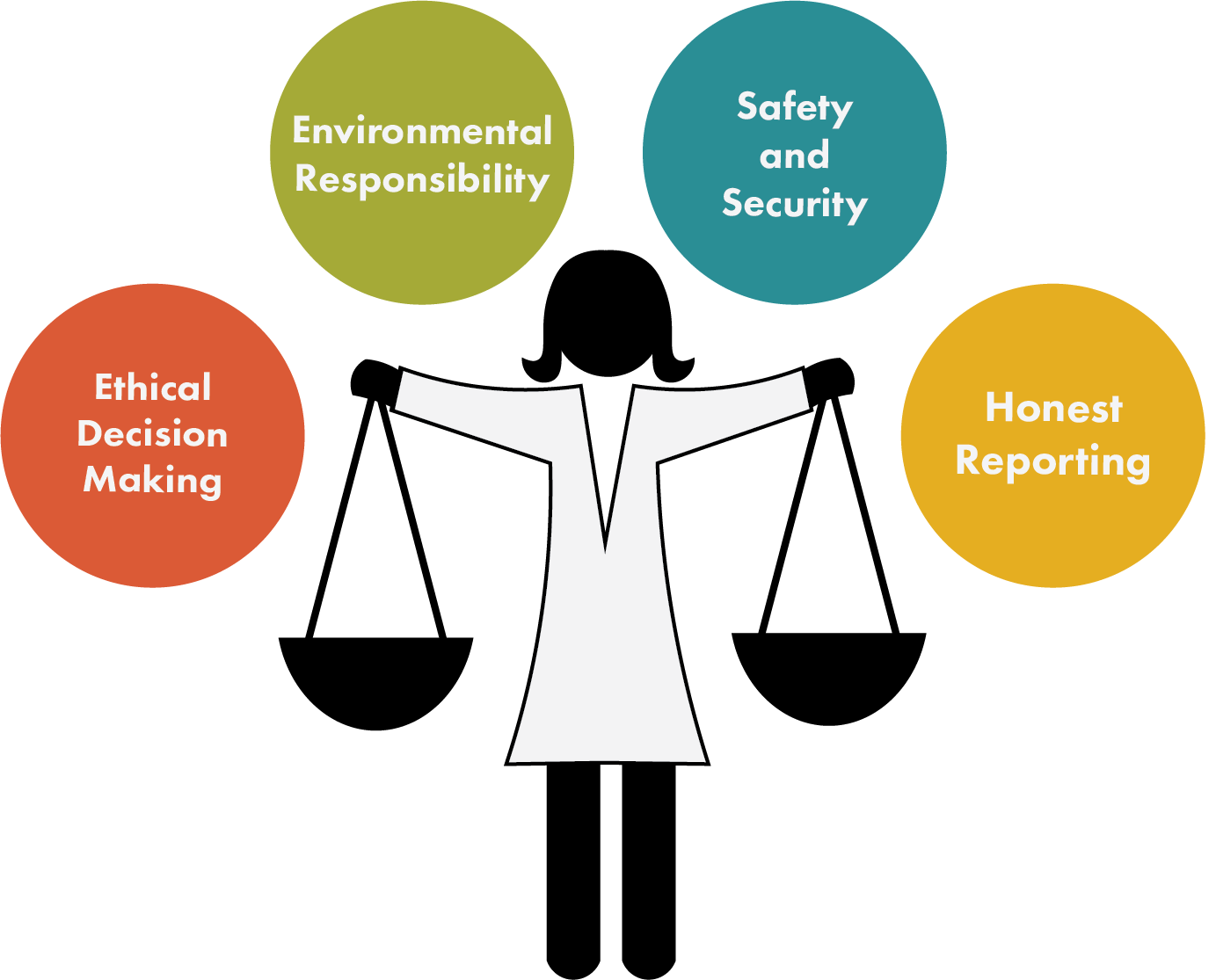
Chemists should follow these suggested behaviours to preserve the integrity of their profession and to advance the public good:
- Consider the broader implications of your scientific work, including potential societal impacts and the responsible use of new technologies.
- Implement green chemistry principles in chemical research and production, including waste reduction and sustainable resource use, to minimize the environmental impact.
- Prioritize eco-friendly chemicals, engage in educational programs on safety and ethics, and stay updated on green chemistry advancements.
- Follow safety protocols rigorously to protect yourself, your colleagues, and the environment from potential hazards associated with chemical research and production.
- Engage in public outreach and education to demystify science, promote scientific literacy, and encourage ethical practices in the wider community.
- Collaborate with policymakers, educators, and the public to advocate for responsible chemical use and sustainability.
- Maintain transparency and accountability in research findings, acknowledge errors, and avoid manipulation or fabrication of research results and data.
Questions to Guide Discussion
- Why is it important for chemists to consider the environmental impact of their research and experiments?
- How should chemists handle situations where their research could be used for harmful purposes?
- What are some ways that chemistry-related organisations can maintain professional standards?
- How can chemists ensure that their research findings are reported accurately and honestly, even if the results are not what they expected?
- Why is it important for chemists to share their knowledge and discoveries with the public? How can they do this responsibly?
- What are the potential consequences of not adhering to ethical and professional guidelines in scientific research?
- What factors should chemists consider when making ethical decisions in their professional work?
- How can ethical decision making impact the long-term outcomes of scientific research and development?
- What can we learn from other disciplines in making effective and ethically responsible decisions?
- Why is environmental responsibility important for chemists?
- What are some examples of sustainable practices that chemists can implement in their work?
- Why is adherence to safety standards crucial in the field of chemistry?
- What actions, policies, or processes can be used to improve chemical safety in the laboratory and in production?
- What are some ways chemists can contribute to improving scientific literacy in their communities?
- How does public outreach and education enhance the ethical conduct of chemists?
References
- International Science Council. Standards for Ethics and Responsibility in Science: An Empirical Study. https://council.science/publications/standards-for-ethics-and-responsibility-in-science-an-empirical-study/ (accessed 2025-06-20).
- EuChemS Division of Ethics in Chemistry. https://www.euchems.eu/divisions/ethics-in-chemistry/ (accessed 2025-06-20).
- American Chemical Society. Chemical Professionals Code of Conduct. https://www.acs.org/careers/career-services/ethics/the-chemical-professionals-code-of-conduct.html (accessed 2025-06-20).
- InterAcademy Partnership. Doing Global Science: A Guide to Responsible Conduct in the Global Research Enterprise. https://www.interacademies.org/publication/doing-global-science-guide-responsible-conduct-global-research-enterprise (accessed 2025-06-20).
- United Nations. Sustainable Development Goals. https://sdgs.un.org/goals (accessed 2025-06-20).
- American Chemical Society. 12 Principles of Green Chemistry. https://www.acs.org/greenchemistry/principles/12-principles-of-green-chemistry.html (accessed 2025-06-20).
- Zuin, V. G.; Eilks, I.; Elschami, M.; Kümmerer, K. Education in Green Chemistry and in Sustainable Chemistry: Perspectives towards Sustainability. Green Chem. 2021, 23 (4), 1594–1608. https://doi.org/10.1039/D0GC03313H.
- Horváth, I. T. Introduction: Sustainable Chemistry. Chem. Rev. 2018, 118, 369−371. https://doi.org/10.1021/acs.chemrev.7b00721.
- Colin, T. Toward Sustainable Chemistry. Science 2001, 291, 48–49. https://doi.org/10.1126/science.291.5501.48.
- American Chemical Society. RAMP: Safety and Security. https://institute.acs.org/acs-center/lab-safety/safety-basics-and-ramp/what-is-ramp.html (accessed 2025-06-20).
- Cannon, A.; Edwards, S.; Jacobs, M.; Moir, J. W.; Roy, M. A.; Tickner, J. A. An Actionable Definition and Criteria for “Sustainable Chemistry” Based on Literature Review and a Global Multisectoral Stakeholder Working Group. RSC Sustain. 2023, 1 (8), 2092–2106. https://doi.org/10.1039/D3SU00217A.
- Slootweg, J. C. Sustainable Chemistry: Green, Circular, and Safe-by-Design. One Earth 2024, 7 (5), 754–758. https://doi.org/10.1016/j.oneear.2024.04.006.
- Organisation for the Prohibition of Chemical Weapons. The Hague Ethical Guidelines. https://www.opcw.org/hague-ethical-guidelines (accessed 2025-06-20).
- Beyond Benign. https://www.beyondbenign.org/ (accessed 2025-06-20).
- IUPAC. FAIR Chemistry Updates. https://iupac.org/iupac-fair-chemistry-updates/ (accessed 2025-06-20).
- Szozda, A. R.; Mahaffy, P. G.; Flynn, A. B. Identifying Chemistry Students’ Baseline Systems Thinking Skills When Constructing System Maps for a Topic on Climate Change. J. Chem. Educ. 2023, 100, 1763−1776. https://doi.org/10.1021/acs.jchemed.2c00955.
- Talanquer, V. Some Insights into Assessing Chemical Systems Thinking. J. Chem. Educ. 2019, 96 (12), 2918−2925. https://doi.org/10.1021/acs.jchemed.9b00218.
- York, S.; Orgill, M. K. ChEMIST Table: A Tool for Designing or Modifying Instruction for a Systems Thinking Approach in Chemistry Education. J. Chem. Educ. 2020, 97, 2114−2129. https://doi.org/10.1021/acs.jchemed.0c00382.